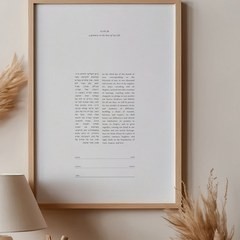

Traditional, Conservative, Reform, interfaith, secular, same sex or genderless: how the main Ketubah texts differ, what each one promises, and how to choose yours.
The short answer
Your Ketubah text is the actual promise you’re signing, so choose it before you fall for a design.
The main options are traditional (Orthodox), Conservative with the Lieberman clause, Reform, interfaith, secular, same sex and genderless.
Orthodox rabbis usually require the original Aramaic. Reform, interfaith and secular texts are written in Hebrew and English.
Ask your rabbi or officiant which texts they accept before you order.
Every Love Letters Ketubah includes custom text and translation, and we send the proof to your rabbi directly.
Couples spend weeks choosing a design and about ten minutes choosing the words. It should be the other way round.
The text is what your witnesses sign and what you’ll read on your wall for the rest of your life. Here’s how the main Ketubah texts differ, what each one actually says, and how to pick yours.
What do you actually write in a Ketubah?
You don’t usually write a Ketubah from scratch. You choose an established text that fits your beliefs and your ceremony, then personalize it with your names, your parents’ names, the Hebrew and English date, and the place of your wedding.
The text itself falls into two families. Traditional texts are legal documents in Aramaic, listing obligations and a financial settlement. Modern texts are statements of mutual love and commitment, usually in Hebrew and English.
Which family you choose depends on three things: your community, your officiant and what you want to promise each other.
How do the main Ketubah texts compare?
Here’s how the main Ketubah texts compare at a glance:
Text | Who it suits | Language | Rabbi approval |
|---|---|---|---|
Traditional (Orthodox) | Couples having an Orthodox ceremony | Aramaic, often with an English translation | Required. The rabbi usually completes it |
Conservative with Lieberman clause | Couples married by many Conservative rabbis | Aramaic plus the clause | Required |
Reform | Couples who want mutual, egalitarian promises | Hebrew and English | Recommended |
Interfaith | Couples from two traditions | Hebrew and English, or English only | Ask your officiant |
Secular or humanist | Couples who want commitment without religious obligations | English, with optional Hebrew | Ask your officiant |
Same sex | Two brides or two grooms | Hebrew and English | Recommended |
Genderless | Couples who want no gendered language at all | Hebrew and English | Recommended |
You can read the full wording of each on our Ketubah texts page.
What does the traditional Orthodox Ketubah say?
The traditional Orthodox Ketubah is an Aramaic contract in which the groom promises to support, honour and provide for his wife, and commits a sum of 200 zuz (100 in a second marriage) to her protection. The wording has stayed essentially unchanged for around 2,000 years (My Jewish Learning).
A short excerpt, in translation, gives a sense of it:
“Be my wife according to the law of Moses and Israel, and I will work for you, honour, support and maintain you, in the custom of Jewish husbands.”
Orthodox rabbis typically require the original Aramaic, and often fill in or check the details themselves (Ink With Intent). If you’re having an Orthodox ceremony, your rabbi should see the text before you order. We walk through the history in what is a Ketubah?
What is the Lieberman clause?
The Lieberman clause is a paragraph added to the traditional text in which both partners agree to go to a beit din (Jewish court) if the marriage ends, so neither can be left unable to remarry under Jewish law. It was adopted by the Rabbinical Assembly and the Jewish Theological Seminary in 1953, and in 1991 a letter of intent was added to help it hold up in US courts (Ritualwell).
It’s named after Saul Lieberman, a Talmud scholar at the Jewish Theological Seminary. It’s used by many Conservative rabbis. Orthodox rabbis rejected it (Wikipedia), so if your rabbi is Orthodox, ask before you add it.
The problem it solves is real. Without it, a woman whose husband refuses a Jewish divorce can become an agunah, literally a “chained woman.” The clause is a quiet, practical safeguard written into a beautiful document.
How are Reform and egalitarian Ketubah texts different?
Reform and egalitarian Ketubah texts are written as equal promises from both partners, focus on the spiritual commitments of marriage, and are usually in modern Hebrew and English rather than Aramaic. Many leave out the financial settlement entirely (My Jewish Learning).
They tend to sound more like vows. Promises to build a home together, to grow, to support each other’s dreams, to create a Jewish home or a home filled with learning and kindness.
One of the best-known alternatives is Rachel Adler’s Brit Ahuvim, the “Lovers’ Covenant,” which reimagines the Ketubah as a partnership between equals.
What should an interfaith couple write in their Ketubah?
An interfaith couple usually chooses a text that keeps the idea of a written promise but adapts the wording so it honours both partners. A common change is replacing “according to the law of Moses and Israel” with something like “according to tradition” (18Doors).
18Doors describes five approaches: a modified traditional text, a text that draws on both traditions, a spiritual text, a secular text and a fully custom one.
Talk to your officiant first. Some rabbis who officiate interfaith weddings have a preferred text. Others are happy with anything that reflects your relationship.
Can we write our own Ketubah text?
Yes. You can write your own Ketubah text, especially for a Reform, interfaith or secular ceremony, as long as your officiant is comfortable with it. For an Orthodox or Conservative ceremony, the core legal text can’t be rewritten, but you can often add a personal English passage alongside it.
If you write your own, a simple structure works well:
The date and place, in Hebrew and English.
Your names, and your parents’ names if you want to include them.
Three to five promises you’re making to each other.
What kind of home you want to build.
Lines for your witnesses and officiant to sign.
Keep it short. Long texts change the layout, and a minimalist design needs room to breathe. We’ll help you trim it, and custom text and translation are included in every order.
How do you choose the right Ketubah text?
Choose your Ketubah text by starting with your officiant, not the design. Ask these questions in this order:
Who is marrying you? If it’s an Orthodox rabbi, the traditional Aramaic text is almost certainly required. If it’s Conservative, expect the Lieberman clause.
What do you want to promise? Legal obligations, mutual vows, or a statement of love?
Which languages do you want to read? Aramaic, Hebrew, English, or a mix?
How do you want the names written? Hebrew names, parents’ names, adoptive parents, converts (often written as child of Abraham and Sarah in the Hebrew).
Once you know the text, pick the design. Our designs, like Scribbles from the Heart and Leaning Into Love, work with every text we offer. Then check your Hebrew wedding date, and read does your rabbi need to approve your Ketubah? before you send the proof.
Ready? Design your Ketubah.
Frequently asked questions
What is the most common Ketubah text?
There isn’t one. Orthodox couples use the traditional Aramaic text, many Conservative couples add the Lieberman clause, and Reform and interfaith couples tend to choose egalitarian texts written as equal promises in Hebrew and English. In practice, your officiant’s movement usually decides which text is the natural fit.
Can a Ketubah be written only in English?
It depends on your officiant. Orthodox rabbis generally require Aramaic, and Jewish law permits other languages only in exceptional circumstances. Reform, interfaith and secular Ketubahs are often written in English, sometimes with a Hebrew version alongside. We offer texts in Hebrew, Aramaic and English, and translation is included.
What text should a same sex couple use?
Same sex couples usually choose an egalitarian text written for two brides or two grooms, or a genderless text that avoids gendered language entirely. Both are written in Hebrew and English. Many Reform, Reconstructionist and some Conservative rabbis officiate same sex weddings and will have a text they prefer.
Does the Ketubah text have to match our wedding vows?
No. The Ketubah and your spoken vows are separate. The Ketubah is a written document signed before the ceremony, while vows are spoken under the chuppah. Some couples echo a line from their Ketubah in their vows, which is a lovely touch, but it isn’t required by any tradition.
How do we include parents’ names in the Ketubah?
Most texts name each partner as the son or daughter of their parents, using Hebrew names. For converts, many rabbis use “child of Abraham and Sarah.” For adoptive parents, blended families or a parent who has died, ask your rabbi. There’s usually a respectful way to include everyone.
Can we change the text after the proof?
Yes. With Love Letters you’ll receive a digital proof within 1–5 days, and revisions are unlimited until you approve it. Share the proof with your rabbi, collect their changes, and we’ll update it. Once you approve the final proof, it goes to print, so check every name and date carefully first.


