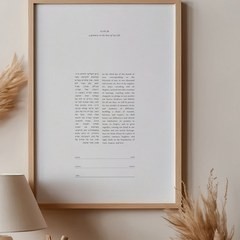

What your rabbi checks, when to ask for approval, who signs on the day, and how we send your proof straight to your rabbi before anything is printed.
The short answer
For an Orthodox or Conservative wedding, yes. Your rabbi must approve the text, and often fills in or checks the details.
For Reform, interfaith or secular weddings, approval is strongly recommended, and your officiant sets the rules for witnesses.
Your rabbi checks the text, the Hebrew names, the Hebrew date and who will sign.
The right moment for approval is the digital proof, before anything is printed.
At Love Letters we send the proof to your rabbi or officiant directly, with unlimited revisions.
It’s the question couples ask most often after “which design?” And the honest answer is: almost always, yes.
Not because rabbis like paperwork. Because the Ketubah is a document your witnesses sign and your rabbi stands behind. Here’s what they check, when they check it, and how to make the whole thing painless.
Does your rabbi need to approve your Ketubah?
Yes, if you’re having an Orthodox or Conservative ceremony, your rabbi needs to approve your Ketubah, because it’s a document in Jewish law that they’re responsible for. For Reform, interfaith and secular ceremonies, it isn’t always required, but your officiant should still see it before you print.
Chabad is direct about why. Some decorative Ketubahs aren’t valid for a traditional ceremony, so couples should check with their rabbi before they buy (Chabad). Even the largest Ketubah retailers tell couples to “run the chosen text by your Rabbi or wedding officiant,” whatever text they choose (Ketubah.com).
The simplest rule: if someone is officiating, they get to see the Ketubah first.
What exactly does your rabbi check?
Your rabbi checks four things: the text, the names, the date and the witnesses. Each one can be different depending on your community and your rabbi’s own practice (Ink With Intent).
What they check | What they’re looking for |
|---|---|
The text | That it’s a version they accept, such as traditional Aramaic, Conservative with the Lieberman clause, Reform or interfaith |
The names | Hebrew names, spellings, parents’ names, and how to write names for converts or adoptive families |
The date | The correct Hebrew date, the weekday, and the shift after sunset |
Blank fields | Whether some details should be left blank for them to fill in by hand |
Witness lines | How many witnesses, and whether the couple and officiant sign too |
Some Orthodox rabbis prefer to fill in parts of the Ketubah themselves. Chabad says the Ketubah “must be filled out by a rabbi who knows the Halakhah,” not by a well-meaning friend or a calligrapher working without instructions (Chabad). If that’s your rabbi’s practice, we can leave those fields blank.
How does rabbi approval differ between Jewish movements?
Rabbi approval is strictest in Orthodox practice and most flexible in Reform, interfaith and secular ceremonies. Here’s how it usually looks:
Orthodox | Conservative | Reform | Interfaith or secular | |
|---|---|---|---|---|
Rabbi approval | Required | Required | Strongly recommended | Ask your officiant |
Typical text | Traditional Aramaic | Aramaic with Lieberman clause | Egalitarian, Hebrew and English | Adapted or custom |
Witnesses | Two Jewish, observant, unrelated men | Usually as Orthodox, varies by rabbi | Age 13 or over, any gender | Set by the officiant |
Who else signs | Rarely the couple | Varies | Often the couple and rabbi | Often the couple and officiant |
For Reform weddings, witnesses must be at least 13 years old and can be of any gender. Many Reform clergy also ask that witnesses aren’t related to the couple or to each other, and some allow three or four witnesses (Reform Judaism).
When should your rabbi approve the Ketubah?
Your rabbi should approve the Ketubah at the proof stage, after the design and text are set but before anything is printed. That’s the moment when changes are free and fast.
Ideally, talk to them twice:
Before you order. Ask which texts they accept, how they want names and the date written, and who can be a witness.
At the proof. Send them the digital proof and ask them to check every word.
Leave approval until the print arrives and any change means reprinting. That’s stressful three weeks before a wedding. Our guide to when to order your Ketubah shows where approval fits in the timeline.
How does the approval process work with Love Letters?
With Love Letters, we work with your rabbi or officiant directly, so approval doesn’t turn into weeks of forwarded emails. Here’s how it works:
You choose your design and text. Compare the options on our Ketubah texts page, then design your Ketubah.
We send a digital proof within 1–5 days. It shows your text, names and Hebrew date set in your design.
We share it with your rabbi. They can reply to us with corrections, and revisions are unlimited.
You approve the final proof. Only then does it go to print, as a giclée on matte archival fine art paper.
Custom text and translation are included, so if your rabbi asks for a specific version or wording, we set it for you.
Rabbis and officiants who recommend Ketubahs to couples can also join our Preferred Partner Program.
Who signs the Ketubah on the wedding day?
On the wedding day, two witnesses sign the Ketubah, usually about 30 minutes before the ceremony, with close family and the wedding party present (18Doors). In interfaith Ketubahs, the signers are often the couple, two witnesses and the officiant (18Doors).
For an Orthodox ceremony, witnesses must be adult Jewish men who are observant and not related to the couple (Chabad). Your rabbi chooses or approves them, so ask before you invite anyone to sign.
A simple signing-day kit helps:
A firm, clean board to lay the unframed Ketubah on.
A fine pen with archival ink. Test it on a scrap of similar paper first.
A list of each signer’s name, spelled exactly as it should appear.
A soft cloth and clean hands. Matte paper shows fingerprints.
Can you have a Ketubah without a rabbi?
Yes, you can have a Ketubah without a rabbi, especially for a secular, humanist or interfaith ceremony led by another officiant. You’ll use a text that doesn’t depend on Jewish law, such as a secular or custom text, and your officiant decides who signs.
What you can’t do is use a traditional Orthodox or Conservative text without a rabbi and expect it to hold in Jewish law. If a halachic ceremony might matter to you or your family later, speak to a rabbi now.
New to all this? Start with what is a Ketubah?, check the Hebrew date of your wedding, and look up any unfamiliar words in our Jewish wedding glossary. Then browse our Ketubahs.
Frequently asked questions
Does a Ketubah need to be signed by a rabbi?
Not always. What makes a traditional Ketubah valid is the signatures of two qualified witnesses. Many rabbis sign as well, and in Reform and interfaith ceremonies the rabbi or officiant often signs alongside the couple. Your officiant will tell you whose signatures they want on the document.
Can a non-Jewish friend sign our Ketubah?
It depends on your ceremony. Orthodox and Conservative weddings require Jewish witnesses who meet specific criteria. In Reform practice, some clergy allow people of other faiths to sign, and interfaith Ketubahs often do. Non-Jewish friends and family can also take part in other ways, such as reading or holding the chuppah.
How many witnesses does a Ketubah need?
A Ketubah needs two witnesses. Some Reform clergy allow three or four, and interfaith Ketubahs often add lines for the couple and the officiant too. Ask your rabbi how many signature lines they want, and we’ll design your Ketubah with exactly that number so no line is left empty.
What if my rabbi wants changes after the proof?
That’s exactly what the proof is for. Send us your rabbi’s changes, or have them reply to us directly, and we’ll update the proof. Revisions are unlimited until you approve it. Only the final approved proof goes to print, so there’s no cost to getting it right first.
Can the rabbi fill in the Ketubah by hand?
Yes. Some rabbis, especially Orthodox rabbis, prefer to write certain details by hand on the day, such as names or the date. Tell us which fields to leave blank and we’ll design the space for them. Test their pen on similar paper beforehand so the ink doesn’t bleed.
Do we need rabbi approval for a secular Ketubah?
Not from a rabbi, but your officiant should still read it before you print. A secular or humanist Ketubah doesn’t depend on Jewish law, so the rules are more flexible. Your officiant will tell you who signs, how many witnesses you need, and whether they want their own signature line.


