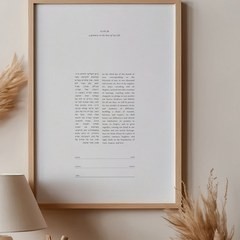

The Jewish marriage contract, explained: what the word means, where it began in 449 BCE, what the Aramaic text actually promises, and why couples now hang it as art.
The short answer
A Ketubah is the Jewish marriage contract, signed by two witnesses just before the ceremony.
The name comes from the Hebrew root k-t-v, “to write.” The oldest known marriage document of this kind dates to 449 BCE.
The traditional Aramaic text lists the promises one partner makes to the other, including a set sum of 200 zuz.
Modern couples choose between traditional, egalitarian, interfaith and secular texts, often with an English translation beside the original.
Most couples frame it and hang it at home, which is why the design matters as much as the words.
Most people meet their first Ketubah on someone else’s wall. Framed in a hallway, covered in script they can’t read, beautiful and a little mysterious. Then they get engaged and suddenly it’s on their to-do list.
Here’s what it actually is, where it came from, and what the words on it promise.
What is a Ketubah?
A Ketubah is a Jewish marriage contract: a written document, signed by two witnesses, that sets out the commitments made in a marriage. The word comes from the Hebrew root k-t-v, meaning “to write,” so a Ketubah is literally “the written thing.”
It’s signed shortly before the chuppah (the wedding canopy), often read aloud during the ceremony, and handed to the couple afterwards. In traditional practice it belongs to the bride, and she keeps it for life.
What makes it unusual is the mix. It’s a legal document, a religious object and, for most modern couples, a piece of art that hangs in their home for decades. Few other contracts get framed.
Where does the Ketubah come from?
The Ketubah comes from ancient Jewish law, and it’s one of the oldest continuously used legal forms in the world. The earliest known example is an Aramaic marriage document written for a couple named Ananiah and Tamut in Elephantine, Egypt, in 449 BCE. The oldest one found in Israel, written on a piece of pottery at Maresha, dates to 176 BCE (Wikipedia).
The rules were set down in the Mishnah, around 200 CE. It fixes the sum a husband owes: “with regard to a virgin, her marriage contract is two hundred dinars, and with regard to a widow, her marriage contract is one hundred dinars” (Mishnah Ketubot 1:2, Sefaria).
That money was the whole point. The Ketubah existed to protect a wife if the marriage ended through divorce or death. The Talmud tells how, at first, husbands had to set the sum aside in cash, and men “would grow old and would not marry.” The sage Shimon ben Shetach fixed it by making all of a husband’s property a guarantee for the Ketubah instead (Ketubot 82b, Sefaria).
So, a surprisingly progressive document for its time. Two thousand years ago it gave women financial security in writing.
What does a traditional Ketubah actually say?
A traditional Ketubah says, in Aramaic, that on a specific date and in a specific place, the groom asked the bride to be his wife, promised to support her, and committed a sum of money to her protection. The core wording has stayed essentially unchanged for about 2,000 years (My Jewish Learning).
Read line by line, it covers:
Part of the text | What it says in plain English |
|---|---|
Date and place | The Hebrew date, the day of the week and the city where the wedding happens |
Names | The full Hebrew names of the couple, usually with their parents’ names |
The proposal | “Be my wife according to the law of Moses and Israel” |
Obligations | Food, clothing and marital intimacy, plus care if she is ill or captured |
The sum | 200 zuz (or 100 in a second marriage), guaranteed by all his property |
Her dowry | What she brings into the marriage, and how it’s protected |
Acceptance | Both sides agree, and the groom formally takes on the obligations |
Witnesses | Two witnesses sign to confirm it all happened |
Chabad counts ten specific obligations in total, and puts the value of the 200 zuz at roughly $750 today (Chabad).
If a word here is new to you, our Jewish wedding glossary covers everything from chuppah to zuz.
Why is the Ketubah written in Aramaic?
The Ketubah is written in Aramaic because Aramaic was the everyday language of Jewish life when the text was formalized, and the legal wording needed to be precise and understood by everyone who signed it (Chabad).
Hebrew was the language of prayer. Aramaic was the language of contracts, markets and courts. So the document that dealt with money and obligations was written in the language people actually did business in.
That’s why Orthodox and many Conservative rabbis still ask for the original Aramaic. Reform, interfaith and secular texts are usually written in modern Hebrew and English instead. Many couples now do both, printing the traditional text beside an English translation so they can read what they signed.
Is a Ketubah legally binding?
A Ketubah is binding in Jewish law, but in most countries it isn’t treated as a civil marriage certificate. Today the Ketubah “has no agreed monetary value, and is seldom enforced by civil courts, except in Israel” (Wikipedia).
So you’ll still need a civil marriage license where you live. Think of the Ketubah as the religious and personal record of your marriage, and the license as the legal one.
How is a Ketubah different from a prenup?
A Ketubah and a prenup both deal with what happens if a marriage ends, but they’re built for different jobs.
Ketubah | Prenuptial agreement | |
|---|---|---|
Purpose | Religious record of the marriage and its promises | Civil contract about assets and support |
Who writes it | Standard text, chosen with your rabbi | Lawyers, for your situation |
Signed by | Two witnesses (and often the couple and rabbi) | The couple, usually with legal advice |
Displayed? | Almost always framed and hung | Filed away, never framed |
Enforced by | Jewish law and a beit din | Civil courts |
Some Conservative couples add the Lieberman clause to their Ketubah, which commits both partners to a Jewish court if the marriage ends. Our guide to Ketubah text examples explains how it works.
When did the Ketubah become art?
The Ketubah became art when communities began decorating it, and most of the illustrated Ketubahs that survive date from the 18th to the early 20th century. Italian Ketubahs included painted human figures, Ketubahs from Muslim lands favoured plants and animals, and Ashkenazi communities mostly kept them plain (Yale Beinecke Library).
Each community decorated the same legal text in its own visual language. The words stayed fixed. The art told you where the couple lived and what they found beautiful.
We think the modern minimalist Ketubah is simply the next chapter of that story. Clean type, generous white space, a design that sits as naturally in a calm modern home as an illuminated Italian Ketubah did in a Venetian one. We started Love Letters because we wanted a Ketubah we’d choose for our walls anyway.
What do modern couples put on their Ketubah?
Modern couples choose a text that matches how they see their marriage, then personalize it with their names, date and place. The main options are:
Traditional (Orthodox): the classic Aramaic text, unchanged.
Conservative: the traditional text, often with the Lieberman clause added.
Reform and egalitarian: mutual promises written in Hebrew and English.
Interfaith: wording that honours both partners’ backgrounds.
Secular or humanist: a statement of love and commitment without religious obligations.
Same sex and genderless: texts written for every couple.
You can compare the wording on our Ketubah texts page. Every Love Letters Ketubah includes your custom text and translation, and we work directly with your rabbi or officiant on the details.
What happens to the Ketubah on the wedding day?
On the wedding day the Ketubah is signed by two witnesses, usually about 30 minutes before the ceremony, with close family and the wedding party watching (18Doors). Then it’s often read aloud under the chuppah and given to the couple.
After the wedding it goes home, gets framed and goes on the wall. A Ketubah is meant to be seen. Our feature on displaying your Ketubah has five ways to hang it, and how to frame your Ketubah covers glass, mats and sizes.
Planning the rest? Start with when to order your Ketubah and how to find the Hebrew date of your wedding. Or browse our designs and see which one you’d want to look at every morning.
Frequently asked questions
What does the word Ketubah mean?
Ketubah comes from the Hebrew root k-t-v, which means “to write,” so the word means “that which is written.” The plural is Ketubot or Ketubahs. You’ll also see it spelled Ketuba or Kesubah, depending on whether the speaker uses Sephardic or Ashkenazi Hebrew pronunciation. They all refer to the same document.
Who signs the Ketubah?
Two witnesses sign the Ketubah. In Orthodox and Conservative weddings they must be Jewish, observant and unrelated to the couple. In Reform and interfaith weddings the rules are looser, and the couple and officiant often sign too. Your rabbi decides who qualifies, so ask before you choose your witnesses.
Can a non-Jewish or interfaith couple have a Ketubah?
Yes. Interfaith and secular Ketubah texts are written for couples where one or both partners aren’t Jewish. They keep the idea of a written promise but adapt the wording, for example changing “according to the law of Moses and Israel” to “according to tradition.” Your officiant will guide which version fits your ceremony.
Do you need a Ketubah to be married?
In Jewish law, yes: a traditional Jewish wedding requires a Ketubah, and a couple shouldn’t live together without one. For a civil marriage, no. The Ketubah doesn’t replace your marriage license. Most couples have both: a license for the state and a Ketubah for their tradition and their wall.
Where do you hang a Ketubah?
Most couples hang their Ketubah somewhere they’ll see it every day, like a living room, entryway or bedroom. Keep it out of direct sunlight and frame it behind UV-filtering glass so the paper and ink don’t fade. A larger size, like 24×36 inches, makes a strong focal point above a sofa or console.
How much does a Ketubah cost?
A Ketubah can cost anything from a printable template to several thousand dollars for a hand-painted commission. Love Letters Ketubahs start from $420 and include custom text, translation, a digital proof with unlimited revisions, a museum-quality giclée print and free worldwide shipping. See our Ketubah designs for sizes and prices.


