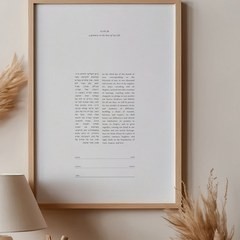

Frame your Ketubah the way a gallery frames a work on paper: the right mat, glass and frame size for each print, and where to hang it so it lasts.
The short answer
Frame your Ketubah the way a gallery frames a work on paper: acid-free mat, UV-filtering glazing, and nothing touching the print.
Choose glazing that blocks at least 99% of UV light. Museum glass adds anti-reflective clarity.
Use a wide mat and a slim frame for a modern, art-like look. Let the white space do the work.
Hang it out of direct sun. All light fades paper over time, not just UV.
Love Letters Ketubahs ship unframed, so you can choose a frame that suits your home.
A Ketubah is the only contract most people ever frame. So frame it like the artwork it is.
The difference between a Ketubah that looks like a certificate and one that looks like art is almost never the print. It’s the mat, the frame and where you hang it. Here’s how to get all three right.
How do you frame a Ketubah so it looks like art?
To frame a Ketubah so it looks like art, give it a wide acid-free mat, a slim, simple frame, and anti-reflective glazing, then hang it at eye level in soft light. That’s how galleries frame works on paper, and it works just as well at home.
Think restraint. Ornate gold frames and double mats in contrasting colours pull the eye away from the Ketubah. A clean white or off-white mat and a thin frame in natural wood, black or white let the design and the lettering carry the room.
What materials protect a Ketubah from fading?
The materials that protect a Ketubah are conservation-grade: 100% cotton rag mat board, archival hinges or corners, and glazing that filters UV light. The Northeast Document Conservation Center recommends a mat of at least 4-ply cotton rag, glazing that filters at least 99% of UV, and a gap so the artwork is never in contact with the glass (NEDCC).
Here’s the checklist to take to your framer:
Component | Ask for | Avoid |
|---|---|---|
Mat | 100% cotton rag, acid-free, 4-ply or thicker | Standard paper mats, which yellow over time |
Mounting | Archival photo corners or Japanese paper hinges | Self-adhesive tape and dry mounting |
Backing | Acid-free foam board or rag board | Kraft paper and ordinary cardboard |
Glazing | Conservation glass or acrylic with 99% UV filtering | Plain glass or plain acrylic |
Spacing | A mat or spacer so the print never touches the glazing | Pressing the print flat against the glass |
Dry mounting is the one to watch. It glues the print permanently to a board. It’s cheap and flat, and it can’t be undone.
Should you use glass or acrylic for a Ketubah?
Use either, as long as it filters UV. Acrylic is lighter, less brittle and safer to handle, which makes it good for large frames and for shipping, but it scratches more easily and can bow in very large sizes (Library of Congress). Glass is harder and stays flatter, but it’s heavier.
If you want the Ketubah to look like it isn’t behind glass at all, ask for museum glass. Tru Vue’s Museum Glass blocks up to 99% of UV light and has less than 1% reflection (Tru Vue). It costs more, and it’s the single upgrade that makes the biggest visual difference, especially on a wall facing a window.
What frame size do you need for your Ketubah?
The frame size depends on your print size and how wide you want the mat. A wider mat makes a Ketubah feel more like gallery art. Here’s what we recommend for each Love Letters size:
Print size | Suggested mat | Approximate frame size | Look |
|---|---|---|---|
16×20 inches | 2 inches | 20×24 inches | Standard frame size, easy to find ready-made |
16×20 inches | 3–4 inches | 22×26 to 24×28 inches | More gallery-like, needs custom framing |
24×24 inches | 3–4 inches | 30×30 to 32×32 inches | Square and modern, lovely above a bed |
24×36 inches | 2–3 inches, or float | 28×40 to 30×42 inches | A statement piece for a living room wall |
Two notes. Mats usually overlap the print edge by about a quarter inch on each side, so tell your framer if you want the full design visible. And for the largest size, a float mount (where the print sits on top of the mat with a visible border around it) looks beautifully modern.
Which frame styles suit a modern Ketubah?
Slim, simple profiles suit a modern Ketubah best. A frame between half an inch and one inch wide keeps the attention on the artwork.
Three combinations we love:
Natural oak with a white mat. Warm and calm. Works in almost any room.
Thin matte black with a wide white mat. Graphic and crisp, especially for Bold & Beloved.
Gallery white with an off-white mat. Almost disappears on a white wall, so the design seems to float.
Match the frame to the room, not the wedding. Your Ketubah will hang in your home for decades, long after the wedding colours are forgotten.
Where should you hang your Ketubah?
Hang your Ketubah where you’ll see it every day, out of direct sunlight, with the centre at roughly eye level. The Library of Congress notes that “all light is damaging to paper, not just ultraviolet light,” so even with UV glass, avoid walls that get strong afternoon sun (Library of Congress).
Good places: a living room wall, above a sofa or console, a bedroom, or an entryway where guests see it first. Avoid bathrooms and kitchens, where humidity and heat can damage paper over time.
Want ideas for the wall around it? Our feature on the art of displaying your Ketubah has five layouts, from a simple pair to a full gallery wall.
Should you frame your Ketubah before or after the wedding?
You can do either, but many couples frame it after the wedding, because the witnesses need to sign it on the day. Signing on an unframed print laid on a firm, clean board is much easier than working around a mat.
If you want it on display at the reception, frame it beforehand and ask your framer to leave the back accessible, or keep the signing lines clear of the mat. Or use a simple two-step plan: sign it on the day on a board, display it on an easel, then take it to the framer after the honeymoon.
Plan the timing with our guide to when to order your Ketubah.
Why do Love Letters Ketubahs ship unframed?
Love Letters Ketubahs ship unframed so you can choose a frame that suits your home, and so the print travels safely. Each one is a giclée print on matte archival fine art paper, lightly textured and museum quality, which takes beautifully to conservation framing.
Unframed also means lighter shipping, and shipping is free worldwide. Then you can work with a local framer who can see your print, your wall and your taste in person.
Find the size that fits your wall in our Ketubah designs. Square designs like Big Love look lovely framed at 24×24. When you’re ready, design yours. New to Ketubahs altogether? Start with what is a Ketubah?
Frequently asked questions
How much does it cost to frame a Ketubah?
It depends on the size, glazing and whether you go custom. A ready-made frame in a standard size costs far less than custom framing with a cotton rag mat and museum glass. For an heirloom you’ll keep for decades, conservation materials are worth it. Ask your framer to quote conservation clear and museum glass side by side.
Can I use a ready-made frame for my Ketubah?
Yes. A 16×20 inch Ketubah fits standard 20×24 inch frames with a 2 inch mat, and many ready-made frames come with acid-free mats. Check that the glazing filters UV, and replace any backing that isn’t acid-free. For 24×24 and 24×36 inch prints, custom framing is usually easier.
How do I keep my Ketubah from fading?
Use glazing that blocks at least 99% of UV light, hang it away from direct sun, and keep it out of humid rooms. Conservation guidance is clear that all light damages paper over time, so indirect light is best. An acid-free mat and backing stop the paper from yellowing from behind.
Should the Ketubah touch the glass?
No. The print should never touch the glass or acrylic. Direct contact can trap moisture and cause the paper to stick or stain over time. A mat creates the gap naturally. If you prefer no mat, ask your framer for hidden spacers that hold the glazing away from the print.
What colour mat is best for a Ketubah?
White or soft off-white mats suit almost every Ketubah and make the design feel like gallery art. Choose a mat that matches the paper tone of your print so the edges blend. Avoid strong colours and double mats in contrasting shades, which tend to date quickly and pull focus.
Can the witnesses sign a framed Ketubah?
It’s possible if the signing lines sit inside the mat opening, but it’s awkward and you risk smudging the glass or the print. Most couples sign the unframed Ketubah on a firm board on the day and frame it afterwards. Test your pen on a scrap of similar paper first.


